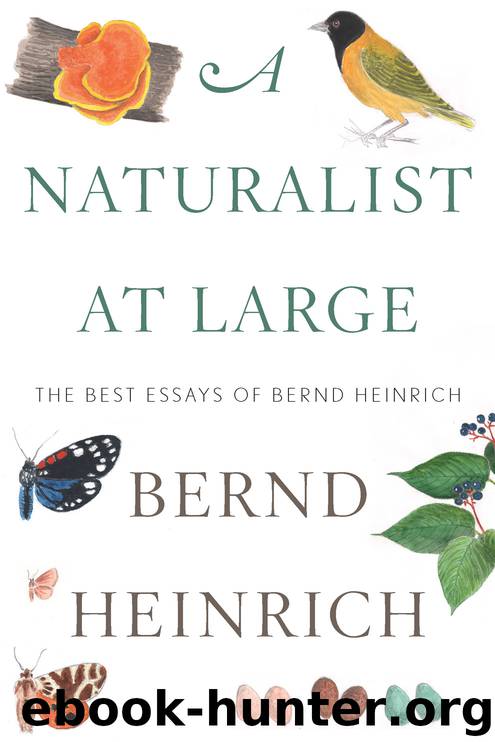
A Naturalist at Large by Bernd Heinrich
Author:Bernd Heinrich
Language: eng
Format: epub
Publisher: Houghton Mifflin Harcourt
The phoebe pair spends little time around the house after July. In mid-September we commonly hear and see the pair, but only for a day or two. As the foliage brightens and the forest turns silent, they leave. I always miss these lively housemates until they return the following spring.
Conversation with a Sapsucker
Natural History, November 2016
One summer, I literally ran across a woodpecker while out running. The bird popped up at my feet—fluttering and floundering—trying to get out of my way but unable to fly. There was obviously something wrong with it. As I picked it up to examine, it screamed loudly in protest. It was fully feathered and its garb fit that of a juvenile yellow-bellied sapsucker (Sphyrapicus varius). I couldn’t distinguish its sex, because the red on the throat of males of this species—found even in juvenile garb—is acquired somewhat later. I found no sign of a broken wing bone or any other injury. Its keel was sharp, however, indicating that its flight muscles were atrophied. No parents were around and, likely, it had not been fed for days.
The bird’s condition did not entirely surprise me. In early spring this year, the weather had been promising enough for birds to start their usual full clutches, but then there had been days of gushing rain and cold, which negatively affect insect populations. Before the rains came, there had been bumblebees (all queens), so by now I had expected an abundance of offspring—worker bees swarming over blooming fireweed, meadowsweet, milkweed, dogbane, and American chestnut trees. But instead I rarely saw even one. Bumblebees are conspicuous. Other insects, which I notice less often, must have also been affected. In any case, a link in the food chain had been broken, which would impact the birds: not all the young get fed in times of poor weather. This bird, although it had been fed enough to fledge, had then lost the strength to fly. It was doomed to starve if left where it was.
As I held it in my hands, it fluffed out its head feathers and vented vociferously. I waited for its parents to come to its cries. None came, and I had to make a decision. I could leave the bird and trot on, certain of its fate, or I could intervene. I subscribe to the principle that one should not “mess with nature,” but reality dictated a compromise. We eat, drive cars, clear land, and build homes that disrupt entire ecosystems. Each of us necessarily has a huge impact on innumerable species. Why not help a member of another species in direct need when I had the opportunity? My act of stumbling upon the bird made the decision unavoidable. But to take this sapsucker home meant finding the proper food and a place to house it, and having the time and patience to care for it. As I held it there on the road, I could not assume anything, except the bird’s impossible odds, which dictated that I could do no wrong by trying and failing.
Download
This site does not store any files on its server. We only index and link to content provided by other sites. Please contact the content providers to delete copyright contents if any and email us, we'll remove relevant links or contents immediately.
The Lonely City by Olivia Laing(4801)
Animal Frequency by Melissa Alvarez(4470)
All Creatures Great and Small by James Herriot(4320)
Walking by Henry David Thoreau(3961)
Exit West by Mohsin Hamid(3826)
Origin Story: A Big History of Everything by David Christian(3692)
COSMOS by Carl Sagan(3623)
How to Read Water: Clues and Patterns from Puddles to the Sea (Natural Navigation) by Tristan Gooley(3469)
Hedgerow by John Wright(3360)
How to Read Nature by Tristan Gooley(3341)
The Inner Life of Animals by Peter Wohlleben(3318)
How to Do Nothing by Jenny Odell(3302)
Project Animal Farm: An Accidental Journey into the Secret World of Farming and the Truth About Our Food by Sonia Faruqi(3221)
Origin Story by David Christian(3201)
Water by Ian Miller(3184)
A Forest Journey by John Perlin(3074)
The Plant Messiah by Carlos Magdalena(2934)
A Wilder Time by William E. Glassley(2862)
Forests: A Very Short Introduction by Jaboury Ghazoul(2842)
